mirror of
https://github.com/headroomlabs-ai/headroom.git
synced 2026-08-27 14:17:10 -04:00
 7ab83c5107
## Description 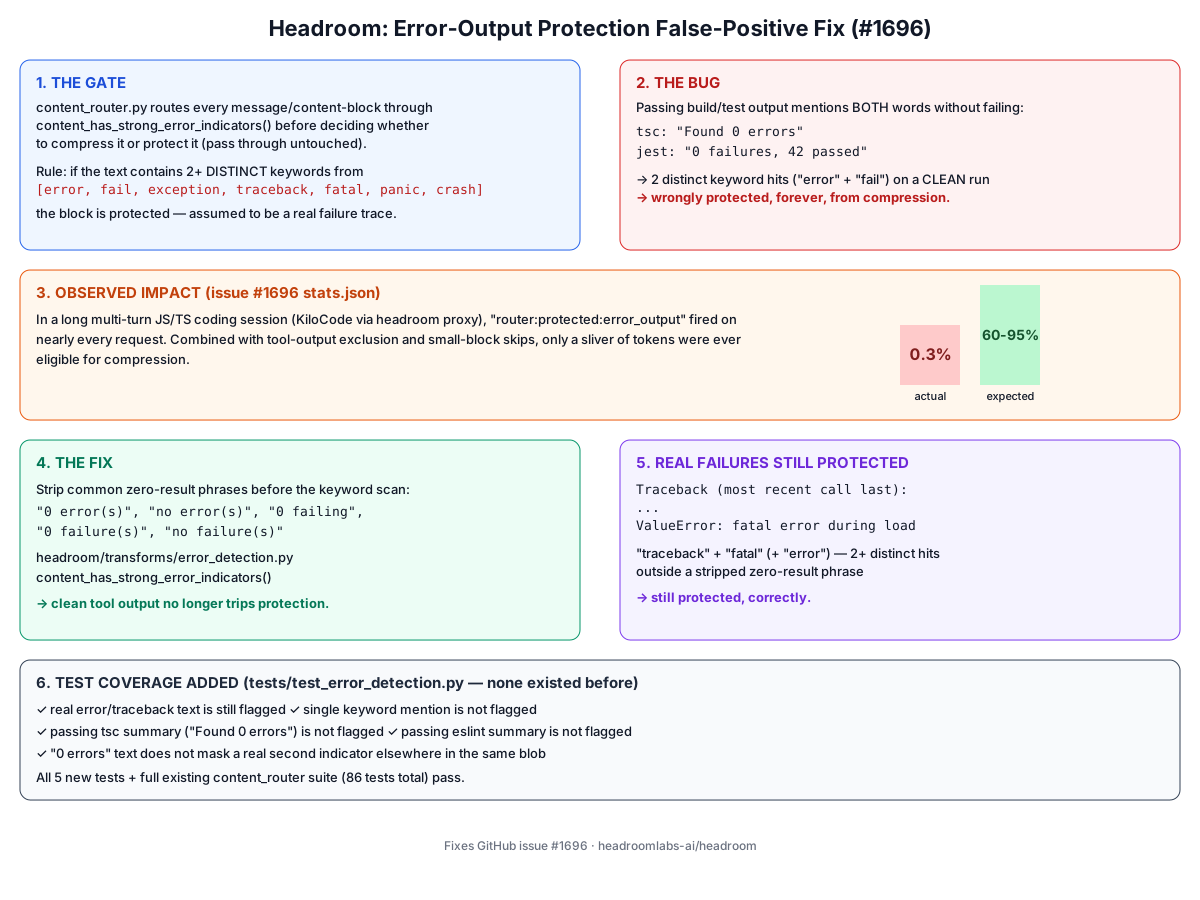 `content_has_strong_error_indicators()` (`headroom/transforms/error_detection.py`) protects any message/content-block from compression when it contains 2+ distinct indicator keywords (`error`, `fail`, `exception`, `traceback`, `fatal`, `panic`, `crash`). That heuristic false-positives on **passing** build/test tool output: `tsc`'s `"Found 0 errors"` plus a passing test run's `"0 failures"` trips both `error` and `fail` — 2 distinct hits — despite nothing failing. In a long JS/TS coding session this fired on nearly every request (confirmed against the `stats.json` attached to #1696), permanently protecting legitimate tool output from ever being compressed and explaining the reported 0.3% savings vs. the advertised 60-95%. Closes #1696 ## Type of Change - [x] Bug fix (non-breaking change that fixes an issue) - [ ] New feature (non-breaking change that adds functionality) - [ ] Breaking change (fix or feature that would cause existing functionality to change) - [ ] Documentation update - [ ] Performance improvement - [ ] Code refactoring (no functional changes) ## Changes Made - `headroom/transforms/error_detection.py`: strip common zero-result phrases before the 2-keyword scan in `content_has_strong_error_indicators()` — both `"N word"`/`"word N"` forms (`"0 errors"`, `"no failures"`) and `"label:value"`/`"label=value"` forms (`"Failures: 0"`, `"errors=0"`), covering `error(s)` and `fail`/`failed`/`failing`/`failure(s)` (the scan matches `fail` by substring, so all inflections needed covering). - `tests/test_error_detection.py` (new file — no prior coverage existed): 7 tests covering real error/traceback detection, single-keyword safety, `tsc`/`eslint` passing summaries, the `"0 failed"` regression a reviewer caught, label:value formats, and that a genuine second indicator elsewhere in the same blob still triggers protection. - `.github/pr-images/issue-1696-error-protection-fix.svg`: diagram explaining the mechanism (embedded above). ## Testing - [x] Unit tests pass (`pytest`) - [ ] Linting passes (`ruff check .`) — not run locally, CI `lint` check is green - [ ] Type checking passes (`mypy headroom`) — not run locally, CI is green - [x] New tests added for new functionality - [x] Manual testing performed (see Real Behavior Proof) ### Test Output ```text $ .venv/Scripts/python -m pytest tests/test_error_detection.py tests/test_transforms/test_content_router.py tests/test_transforms_content_router.py -q tests\test_error_detection.py ....... [ 7%] tests\test_transforms\test_content_router.py ........................... [ 34%] ........................... [ 62%] tests\test_transforms_content_router.py ................................ [ 94%] ..... [100%] ============================= 98 passed in 1.21s ============================== ``` ## Real Behavior Proof - Environment: Windows 11, Python 3.14.5, local venv, `headroom._core` built via `maturin develop --release` (not prebuilt in a fresh checkout) - Exact command / steps: ran the reporter's exact scenario patterns (`"Found 0 errors\nTests: 0 failures, 42 passed"`, eslint's `"0 problems (0 errors, 0 warnings)"`) through `content_has_strong_error_indicators()` directly, before and after the fix - Observed result: before → `True` (wrongly protected); after → `False` (correctly compressible). Real failure text (`Traceback... fatal error`) still returns `True` after the fix. - Not tested: have not reproduced the full KiloCode/proxy session end-to-end locally (no access to the reporter's actual traffic) — root cause was confirmed via the `stats.json` they attached to the issue, which shows `router:protected:error_output` firing on nearly every request in their session. ## Review Readiness - [x] I have performed a self-review - [x] This PR is ready for human review ## Checklist - [x] My code follows the project's style guidelines - [x] I have performed a self-review of my code - [x] I have commented my code, particularly in hard-to-understand areas - [ ] I have made corresponding changes to the documentation (N/A — internal heuristic, no user-facing docs reference it) - [x] My changes generate no new warnings - [x] I have added tests that prove my fix is effective or that my feature works - [x] New and existing unit tests pass locally with my changes - [ ] I have updated the CHANGELOG.md if applicable (release-please generates this automatically from commit messages) ## Screenshots (if applicable) See the diagram embedded in Description above. ## Additional Notes **Investigation trail**: ruled out `protect_recent_reads_fraction` (proxy already overrides its `0.0` dataclass default to `0.3` in token mode, the default) before confirming the error-protection false-positive via the reporter's `stats.json`. **Response to review comments** (@AbelVM, @sparkbugz): prose mentions like `"Fix the errors in the code."` or `"console.error(...)"` contain only 1 distinct indicator keyword and were already safe under the pre-existing 2-keyword threshold — not something this PR changes. The broader concern about other CI summary formats is addressed above (label:value forms). A case like genuine prose that happens to mention *two* distinct keywords together (e.g. "there are errors and it failed") is a known limitation of a keyword-substring heuristic in general, predates this PR, and is out of scope here — downstream compressors (LogCompressor) still preserve real error lines even when a block isn't gate-protected, so the failure mode there is "slightly stricter than ideal," not data loss. **Response to @JerrettDavis's CHANGES_REQUESTED**: fixed in the follow-up commit — `"0 failed"` is now stripped (previously only `failing`/`failure(s)` were), with a regression test for the exact reproduction given.

58 lines
2.4 KiB
Python
58 lines
2.4 KiB
Python
"""Regression tests for the error/importance detection triage helpers."""
|
|
|
|
from __future__ import annotations
|
|
|
|
from headroom.transforms.error_detection import content_has_strong_error_indicators
|
|
|
|
|
|
def test_real_error_output_is_detected() -> None:
|
|
text = "Traceback (most recent call last):\n ...\nValueError: fatal error during load"
|
|
assert content_has_strong_error_indicators(text)
|
|
|
|
|
|
def test_single_keyword_mention_is_not_flagged() -> None:
|
|
# Only one distinct indicator keyword ("error") — should not trip the
|
|
# two-keyword threshold.
|
|
text = 'Wrote error_handler.py with an "errors": [] field.'
|
|
assert not content_has_strong_error_indicators(text)
|
|
|
|
|
|
def test_tsc_passing_summary_is_not_flagged() -> None:
|
|
# Regression for issue #1696: a clean `tsc` run mentions both "error"
|
|
# and (via "0 failures" in a paired test run) "fail" while reporting
|
|
# success. Previously this tripped the two-keyword heuristic and got
|
|
# the message permanently protected from compression.
|
|
text = "Found 0 errors. Watching for file changes.\nTests: 0 failures, 42 passed"
|
|
assert not content_has_strong_error_indicators(text)
|
|
|
|
|
|
def test_eslint_passing_summary_is_not_flagged() -> None:
|
|
text = "0 problems (0 errors, 0 warnings)\nno failing tests"
|
|
assert not content_has_strong_error_indicators(text)
|
|
|
|
|
|
def test_zero_result_phrase_does_not_mask_a_real_second_error() -> None:
|
|
# "0 errors" is stripped, but a genuine second distinct indicator
|
|
# elsewhere in the same blob must still trigger protection.
|
|
text = "0 errors from linter, but the build crashed with a fatal signal"
|
|
assert content_has_strong_error_indicators(text)
|
|
|
|
|
|
def test_zero_failed_form_is_not_flagged() -> None:
|
|
# Reviewer regression (PR #1740): "0 failed" wasn't covered by the
|
|
# original pattern (only "failing"/"failure(s)"), so "failed" still
|
|
# contributed a "fail" keyword hit alongside "0 errors" and tripped
|
|
# the false positive this fix targets.
|
|
text = "Found 0 errors\nTests: 0 failed, 42 passed"
|
|
assert not content_has_strong_error_indicators(text)
|
|
|
|
|
|
def test_label_value_summary_formats_are_not_flagged() -> None:
|
|
# Broader CI summary formats (not just "N word" / "word N"): label:value
|
|
# and label=value pairs, in either error/fail order.
|
|
for text in (
|
|
"Failures: 0, Errors: 0",
|
|
"failed: 0, errors: 0",
|
|
"Errors=0 Failures=0",
|
|
):
|
|
assert not content_has_strong_error_indicators(text), text
|